A language for physical load

Training,
expressed precisely.

Schema is a language for describing training load. SchemaFit is the brand of tools built around it, beginning with SchemaFit Timer: describe, execute, model and study a workout as one structured object.

Army snatch / model output10:00
58/2@t[16→26 i:3→8]*10#
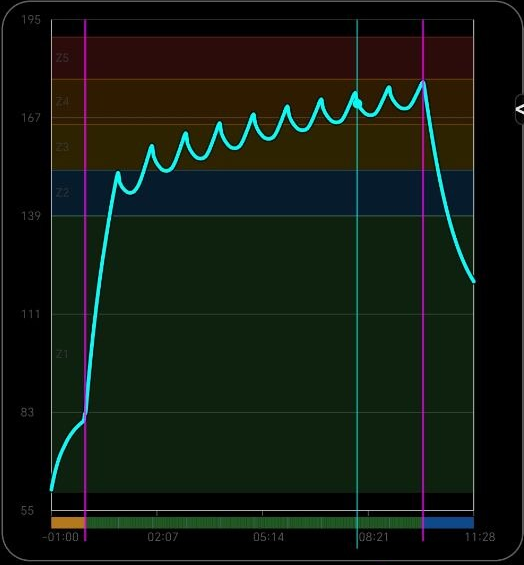
Modeled heart-rate response for ten progressively faster army-snatch intervals, showing ten rising peaks and recovery after the workout
Intensity3 → 8
Tempo16 → 26
Structure10 rounds
00 / IDEA
A workout is more than a list of intervals. It is a system that can be represented, transformed and understood.
01 / SCHEMA

What is the
Schema language?

What is the Schema language? Schema is a compact, human-readable language for describing physical training load: work and recovery, intensity, repetitions, tempo and how they change over time. A Schema can be executed by a timer, modeled, and compared with measured data.

One complete workout
Scan QR code in SchemaFit Timer app
30/210@9.5t30*5#
Five maximal 30-second efforts with 210 seconds recovery.
Readable by people and machines
  • 30/210work and recovery duration
  • @9.5target effort on a 0–10 scale
  • t30movement tempo
  • *5 #repeat five times, then finish
SCHEMA / EXAMPLES

One language.
Wildly different workouts.

A Schema can do more than repeat the same interval. It can shape a finish, draw a tempo wave, generate a repeatable challenge or leave room for what happens in the real session.

Open Full Schema Catalog (30+ Workouts) →

02 / RHYTHM · 10 MIN · TEMPO WAVE
Scan QR code in SchemaFit Timer app

Accelerate. Flow back. Repeat.

[lo=24 hi=36]
(60/0@t[lo->hi]
 60/0@t[hi->lo])*5#

Five continuous waves. Watch the heart-rate response lag behind each rise and settle on each descent.

03 / RANDOM, REPEATABLE · 15 MIN
Scan QR code in SchemaFit Timer app

Surprise, with a memory.

random(
  20/10@7 12/18@9
  30/20@6
  turb:8 dur:900 min:10 seed:31
)#

Variable bursts for a sailing session, with a seed that lets you run the same virtual course again next month.

HOLDGUSTRECOVERREPEAT
04 / REAL-WORLD FLEX · 10 MIN
Scan QR code in SchemaFit Timer app

Let the session write itself.

dur:600(~/0@r~*~)#

Set a ten-minute window, then record the work and repetitions you actually complete. The result becomes a concrete session you can compare.

OPEN WORKLIVE REPSMEASURE
05 / CALISTHENICS · 1 → 8 → 1
Scan QR code in SchemaFit Timer app

A ladder that adjusts as you climb.

[dw=2 dr=2 N=8]
(dw/dr@r1
->[to:auto/auto@rN,delta:+dw/+dr@r+1]
->[to:auto/auto@r1,delta:-dw/-dr@r-1])*1`#

Repetitions rise from one to eight, then descend to one. Work and recovery grow with the target, so each rung gets its own timing.

12345678BACK TO 1
02 / SYSTEM

One object.
Three views.

The same Schema connects the plan, the live session and the physiological response. That continuity is the foundation of the whole system.

01

Describe

Write the intended load once, including change over time and the variables that matter.

02

Execute

Materialize the plan for a person and discipline, then guide the session in real time.

03

Understand

Compare the model with the measured response and refine both the workout and the model.

03 / TIMER

The first
instrument.

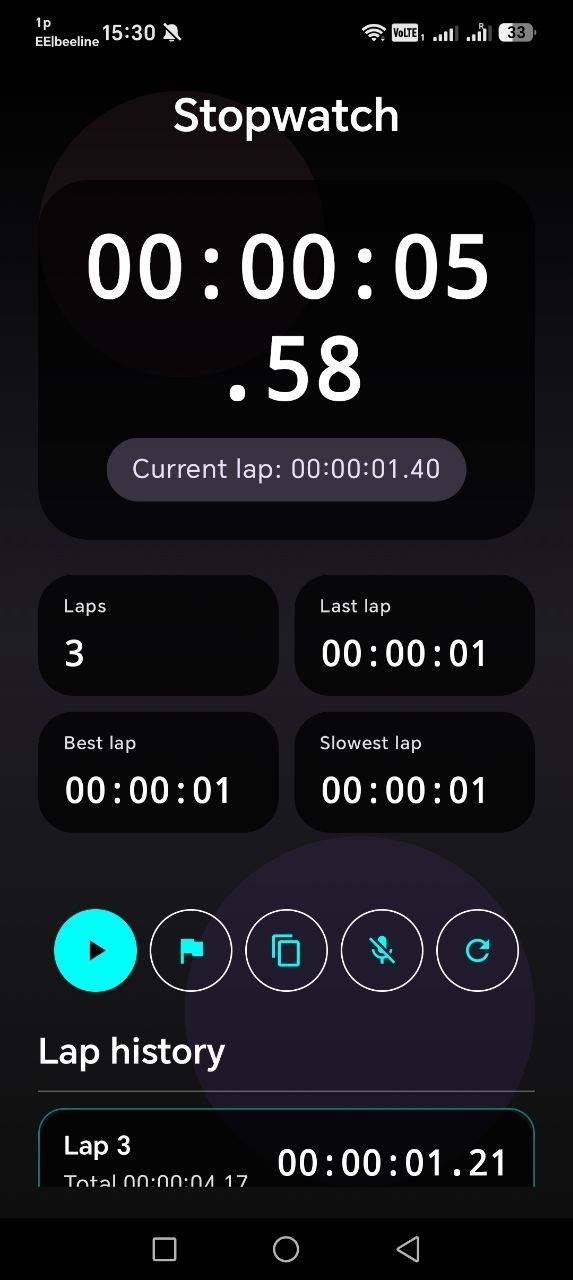
SchemaFit Timer is where the language becomes a session. It combines precise timing, workout structure, heart-rate modeling, live telemetry and post-session comparison in a single offline-first instrument.

SchemaFit Timer

Plan it. Understand it. Then train it.

Run a Schema with real sensors, compare the measured response with your individual model, and refine that model from what actually happened.

Real mode

Live physiological feedback

Heart rate, zones, timing and spoken feedback during the session.

Graph Training

Learn the model by fitting it

Practice Load, Rest, Tau ON/OFF and drift against temporary training curves. Improve the fit, reach 95%+, earn trophies and learn how each parameter changes the response — without touching real HR data or saved curves.

04 / EVIDENCE

Not a concept.
A working instrument.

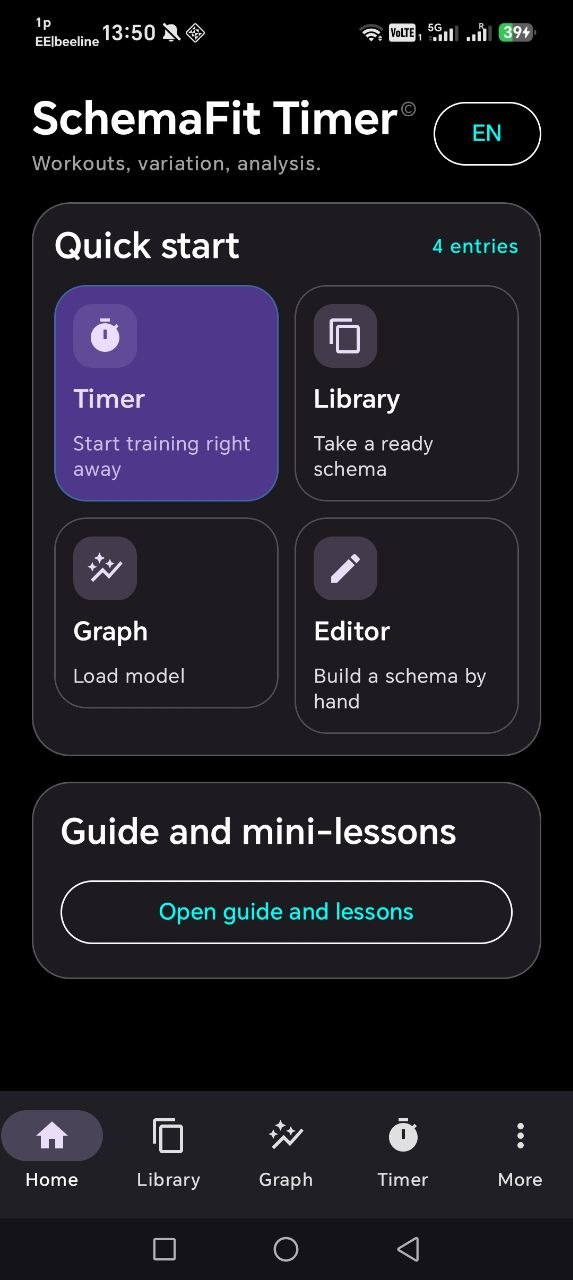
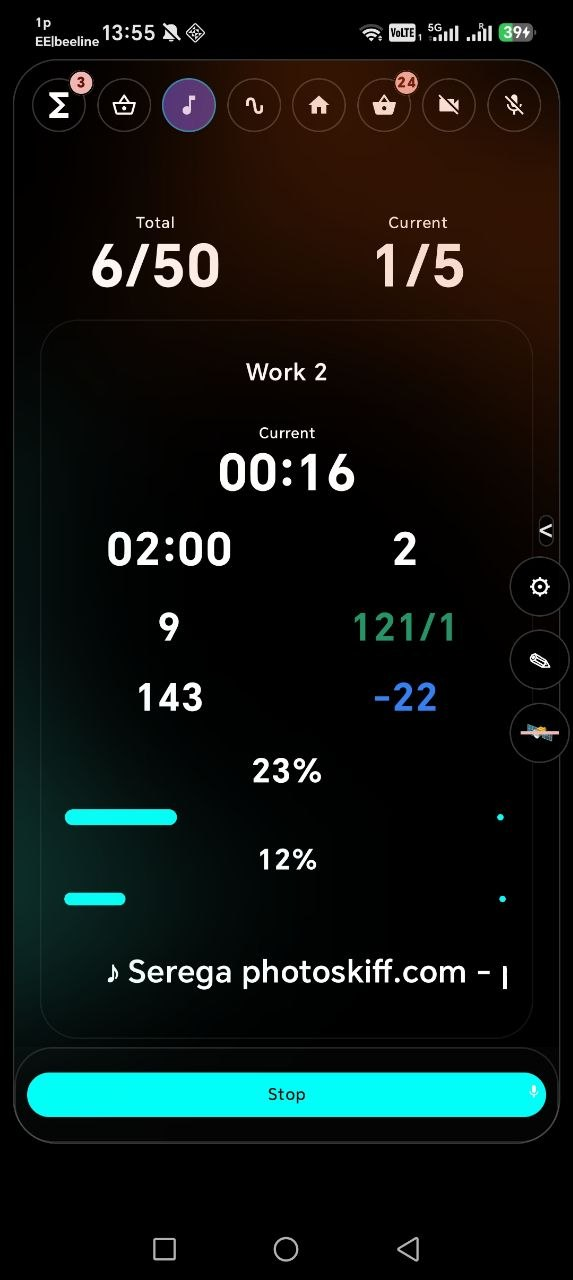
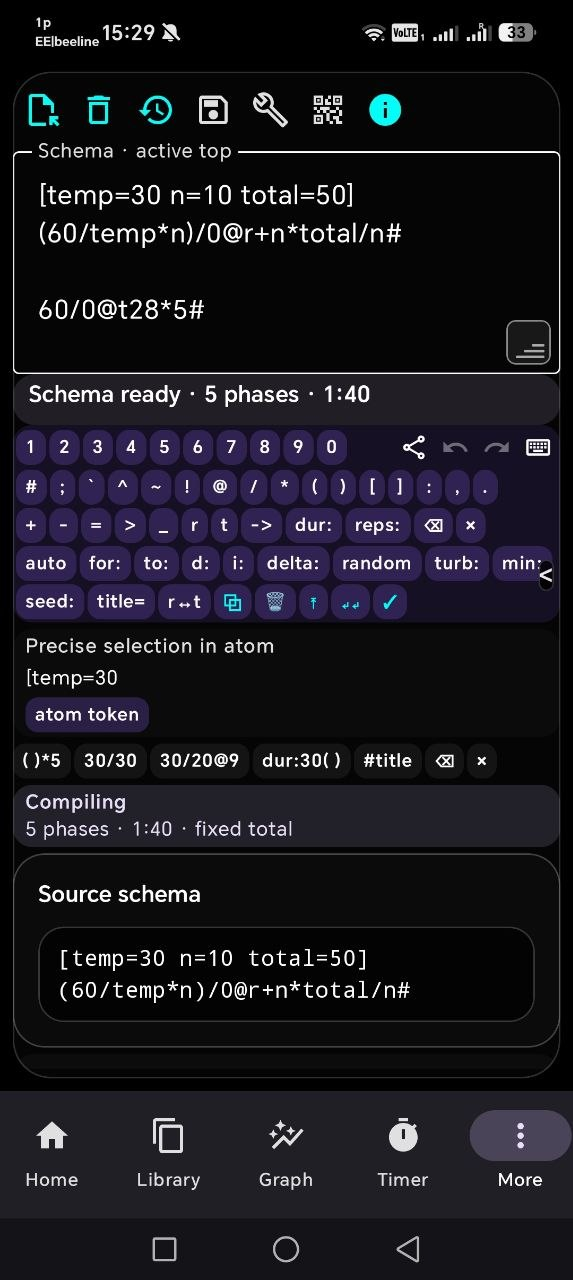
These are real screens from SchemaFit Timer: one system for authoring a Schema, running it, recording the response and testing the individual model against measured heart rate.

Measured, not illustrated

One session.
Plan to evidence.

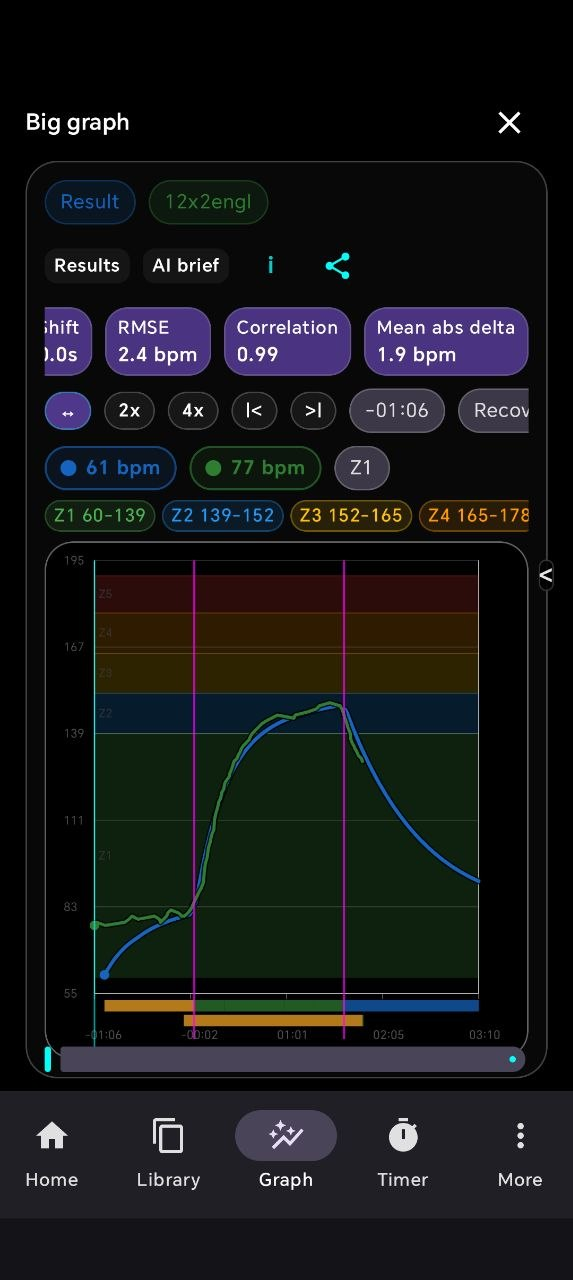
A two-minute, 50-repetition Schema was executed with live heart-rate telemetry. The result was then compared with the personalised response model inside the app.

12×2engl19 SEP 2026
01:59
Heart rate113 / 149
Calories33 kcal
Load3.7 AU
ZonesZ1 77% · Z2 24%
correlation 0.99RMSE 2.4 bpmmean |Δ| 1.9 bpmshift 0.0 s
05 / SMART CURVES

Every attempt
keeps its history.

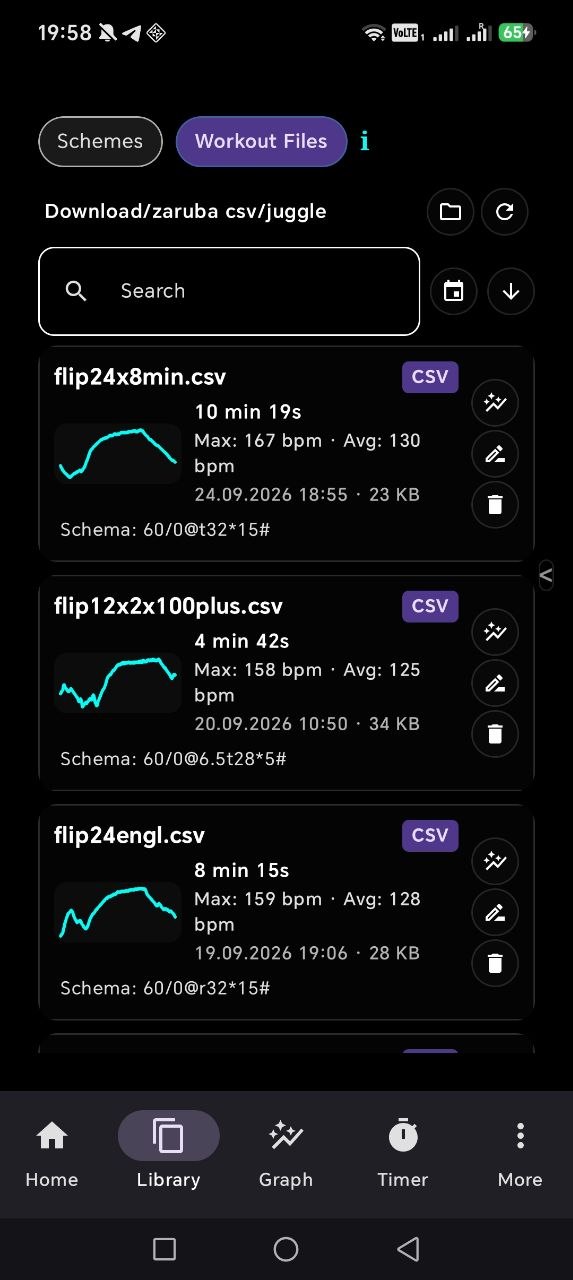
A Smart Curve is more than an HR file. It is a saved training attempt with a persistent curveId, its Schema and analysis context. Link related attempts into a family and see how the athlete's response changes across passes.

Curve family / illustrative

One root. A history of attempts.

Each curve has its own identity. A parentCurveId links a follow-up to its parent, so filenames and folder paths never define the history.

SAVED ATTEMPTS
ROOT
Baseline passcurveId · stable identity
PASS 02
Same protocolparentCurveId · baseline
PASS 03
Cadence changedparentCurveId · pass 02
Record / fit / reuse

Turn a pass into a reference.

  1. Save each important attemptKeep CSV/FIT results in one Smart Curves working folder. Start a new root or choose its parent before export.
  2. Fit the measured responseOn the Graph, choose a clean analysis window and tune intensity, Tau ON/OFF and drift against recorded heart rate.
  3. Hydrate the curveSave the checked model, Schema and analysis window with the curve for future reference.
  4. Compare the next passCompare the same protocol over time, using the model or your own previous heart-rate trace as the reference.

Family comparison keeps context. The root becomes Base; later attempts become Results. A family archive includes source CSV/FIT files and family.json. Related video is matched by curveId and shared separately.

Read the user manual
06 / CAMERA

A video journal
with live telemetry.

The camera is part of the instrument, not an afterthought. It records the athlete and places selected Timer blocks directly into the video while keeping files small enough for everyday use.

SchemaFit Camera

The workout stays visible inside the evidence.

Any Timer information block can become part of the recording: time, repetitions, heart rate, deltas, progress and other live telemetry.

  • 01During the first five seconds after the start, face-aware metering inside the central 60% area establishes focus and exposure, then locks both. At that point the athlete is guaranteed to be in position.
  • 02Every three minutes the camera briefly corrects for changing light and locks exposure again — useful outdoors as evening light changes.
  • 03Manual exposure compensation remains available across a ±2 EV range, alongside a broad choice of recording formats.
  • 04The compact recording mode is engineered for very small files: a ten-minute training video can remain under 100 MB.
Small enough to share without recompression. Small enough to keep — so video can become a genuine training journal instead of a storage problem.
07 / DIRECTIONS

Beyond
the timer.

SchemaFit is designed as a family of tools built around one shared representation of load — across disciplines, devices and research questions.

RUNNER / BIKE

Domain applications

Specialized experiences can materialize the same abstract Schema through pace, power, cadence, terrain or movement tempo.

ENGINE

Modeling & optimization

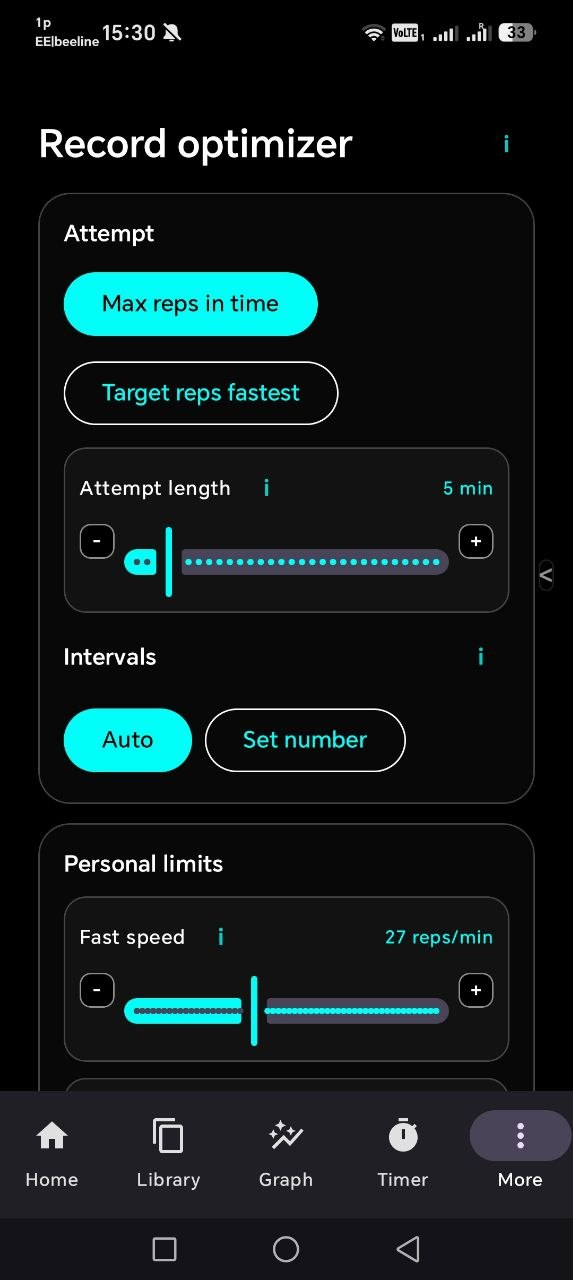
Predict a response, compare alternatives and search for a workout that fits a target, a time limit or an athlete's constraints.

TRANSLATION

Cross-domain equivalence

Use Schema as an intermediate representation to translate comparable load between running, cycling, kettlebells and other domains.

PERSONALIZATION

Models that learn from sessions

Estimate individual response parameters from repeated sessions and make the next prediction more representative.

AI / REVERSE ENGINEERING

From workout
back to Schema.

Reconstruct an explicit Schema from a coach's description, an existing protocol, telemetry or video. AI performs the interpretation; Schema provides an inspectable, editable and executable result that can be modeled, compared and reproduced.

SHARED CORE

Different sports.
One grammar of load.

The applications may look different because their domains are different. Underneath, they can exchange the same structured description instead of reducing every workout to a generic interval list.

08 / ORIGINS

Built from
practice.

SchemaFit did not begin as a speculative software idea. It grew from competitive sport, coaching, repeated self-experimentation and a community that has been recording comparable efforts over time.

Why it had to exist

The missing object was the workout itself.

Timers can count seconds. Sensors can record what happened. Training plans can describe intent in prose. But these three layers rarely share one precise, executable representation.

Schema was created to preserve the structure between intention and response: what changed, when it changed, how it should be materialised in a sport and what can be compared afterwards.

  1. 01Competitive practice exposed the limits of generic interval lists.
  2. 02Community challenges made repeated, comparable efforts visible over months and years.
  3. 03Modeling required a formal description of the input — not heart-rate data alone.
  4. 04The language, Timer and analysis tools emerged as parts of one system.
Field evidence / Photoskiff Zaruba

A living record of adaptation.

Nearly 3,000 published challenge attempts document real training histories across exercises, ages and ability levels. The collection includes rules, rankings, dates, repeated attempts and individual progress — a practical foundation for longitudinal analysis.

≈3,000published attempts
15+standardised challenges
899%largest displayed improvement
61%displayed mean progress

This is observational field data, not a controlled clinical trial. Its value is different: it reveals trajectories, generates hypotheses and shows what sustained practice looks like outside a laboratory.

09 / RESEARCH

Science needs
reproducible load.

Physiological measurements become more useful when the intervention that produced them is explicit. SchemaFit connects a computable protocol with execution, measurement and model revision.

01Describe protocol
02Predict response
03Execute session
04Measure response
05Compare & refine
METHOD / A

Protocol reproducibility

A Schema records timing, intensity, tempo, progression and variability in a machine-readable form that can be shared and rerun.

METHOD / B

Within-person experiments

Repeated sessions support N-of-1 comparisons: the same athlete, controlled changes, explicit assumptions and inspectable outcomes.

METHOD / C

Model validation

Predicted and measured curves can be compared using correlation, timing offset and error measures instead of visual resemblance alone.

R/01

Controlled variability

How deliberate variation in tempo, intensity and interval structure affects adaptation and performance.

R/02

Individual response models

Estimating time constants, drift and recovery from repeated sessions instead of population formulas alone.

R/03

Time and resource efficiency

Comparing protocols by achieved stimulus, time cost and practical constraints.

R/04

Cross-domain mapping

Testing when two very different activities can produce meaningfully comparable load profiles.

R/05

Adaptive prescription

Turning a target physiological trajectory into an executable workout for a chosen domain.

These are research directions, not settled claims. Community records are observational; heart-rate models are approximations; and correlation is not validation by itself. SchemaFit's role is to expose assumptions and make protocols structured, shareable and precisely repeatable — so stronger studies can be designed.

10 / DOCUMENTS

Read the
thinking.

Practical manuals, language tutorials and research-oriented notes. English editions are paired with the original Russian documents.

Practical guideEN · RU

Schema for Dummies

A gradual, example-led introduction: from 30/30# to calibrated load, materialisation and controlled variability.

Language tutorialEN · RU

The Schema Language: From Zero

A structured tutorial covering atoms, groups, repeats, scopes, deferred values, progressions, ramps and random Schemas.

System paperEN · RU

Timer as an Instrument

How the graph, Schema, heart-rate model, real execution and AI-assisted interpretation form one training cycle.

11 / PRINCIPLES

Built with
clear constraints.

The product is shaped by the same values as the language: explicit structure, useful freedom and no hidden noise.

Offline first

Core training and analysis should not depend on a network connection.

No advertising

The free version is a real scientific instrument, not a funnel filled with interruptions.

Honest modeling

A model is presented as a model, with parameters that can be inspected, practiced, compared with reality and refined.